Sometimes audiences were right. That's the phrase, in fact, that inspired this blog. There are many films that flopped over the years but then have been resurrected as classics by us moderns who are so much more enlightened and sophisticated about these things. One such film is "Bringing Up Baby," a screwball comedy that did lackluster business on its first release and was mostly forgotten, until its subsequent resurrection. But this is one case where the revisionists have it wrong. Audiences in 1938 were right to ignore this film, and every modern critic who holds this up as a shining example of the screwball comedy ought to have their head examined.
From the first shots, it's apparent this film is made by a skilled director and actors. Hawks' camera is fluid, and the banter between Cary Grant and Katharine Hepburn shows often impeccable timing. However, two flaws exist which sink this boat before it even leaves port. First, it's not that funny. There are an overabundance of gags and what people who try too hard tend to refer to as "madcap high jinks," but most of them fall flat. Second, and this is most fatal, Hepburn's character, Susan Vance, manages to be both unsympathetic and not make any sense. Cary Grant (and the writers) are no help as he gives no sign of any attraction back in this, what I can only assume to be, "romantic comedy."
You see, Susan wants to marry paleontologist David Huxley (Grant). Why? An animal attraction? In the guise of Katharine Hepburn? Please. Some other reason, perhaps? We're neither shown nor told. We're just supposed to accept she's an absent-minded idle riche who sees a flappable man one day and decides in a beat she wants to marry him. That would be fine for most comedies—a little flimsy, but it wouldn't kill it. However, there's something in the way. David is engaged to be married to an uptight colleague who wants to have a modern marriage where work and career take precedence. After all, uncovering the fossil history of the Earth is important. This is a very modern perspective, but it's portrayed for very regressive reasons. The writers want to make it easy for Grant to part with this shrew and find true love with someone more acceptable. The problem is Hepburn knows he's engaged, practically from the first scene meeting him. This causes her no hesitation, doesn't stop her one moment. In one instance, she actually laughs at his mentioning it.
What follows are several misadventures where Susan and David bump into each other under unfortunate circumstances. He's in Connecticut hunting down one last fossil piece for his dinosaur exhibit while at the same time trying to secure a large donation from the very wealthy Elizabeth Random, who coincidentally is Susan's aunt. Susan uses this to scheme her way into his business and keep him from returning home to get married. This is where the madcap part comes in (lacks key for eyeroll). The bone goes missing, a leopard comes into the picture (the "baby" in the title), and it all crashes together in a long jailhouse sequence which I thought would never end. It's here the film takes a war of attrition approach to comedy. I guess they figure they can wear the audience down and time it just right so you want to laugh and not shoot yourself. I wanted to shoot myself.
All this makes Hepburn's character coldly malicious if you think about it for one-tenth of a second. She barely knows David and never once met his fiancee. Nevertheless, she decides to destroy their lives together, sight unseen. Hepburn's considerable acting skills and charisma do little to win any sympathy because the part is so underwritten. Not that she doesn't have anything to say. She's in practically every scene and has plenty of lines, but it's all so shallow. She exists to serve a construct of screwball plotting and situation with no thought to how to make her resonate as a real person with audiences.
Then there's Grant's side of the equation. He acts like a man continuously in pain at his predicament, and Hepburn's presence does nothing to change his outlook. In fact, I couldn't find one scene or one instance where he seemed to brighten at her presence. In their many entanglements, he constantly complains he wants nothing more to do with her but curiously doesn't act on it. He's strangely passive throughout in a way that's not revealing, but rather opaque. The script doesn't give him any depth, either. This is confirmed in the end when he grabs Hepburn's hand under a collapsing brontosaurus exhibit and rescues her from the wreckage, finally declaring his love for her. He does it with all the enthusiasm of a guy being confronted by a flat tire when walking out to his car. I wasn't convinced by any of this.
The scene in the restaurant with the torn dress—that was funny. If only the reel had run out of film at that point, I'd have said, "Wow, what a lost classic." Unfortunately we have to endure the rest of it.
Saturday, September 27, 2014
Wednesday, August 27, 2014
The Year of Living Dangerously (1982)
When The Year of Living Dangerously first came out, it received some very positive reviews, but many critics had misgivings. Director Peter Weir's cinematic style and vivid portrayal of the tropics won unanimous praise, however, and Linda Hunt bagged a Best Supporting Actress Oscar for it, so it wasn't a failure, by any means. But in the years since, a growing appreciation has gathered around this film, uplifting it to near classic status, which tends to overlook some of the original flaws that undermined its initial reception. There's a patronizing undercurrent that becomes more overt as the storylines are resolved, and a good film is ultimately marred by a Westernized, colonialist-minded ending.
The outlines of the plot are fairly basic. Guy Hamilton, a journalist played by a young and impossibly appealing Mel Gibson, arrives in Jakarta amid the political turmoil of 1965 Indonesia. Green and without contacts, he nevertheless lets his ambition lead the way and enlists the help of Billy Kwan (Linda Hunt), a dwarf photographer who sees potential in the newcomer. After initial success in landing an exclusive with the country's top Communist leader, Guy meets (via Billy) Jill Bryant, a British embassy worker played by Sigourney Weaver. Thus begins a love story with a possible Communist revolution as its backdrop. In fact, it becomes a love triangle of sorts, with Billy playing the matchmaker and master manipulator before taking his tragic turn as protestor and martyr for the people. With Billy gone from the scene, Hamilton finally figures out what he really wants and races to the airport to escape with Bryant just as the country descends to chaos.
First off, I want to give this film credit where credit's due. The look and feel of the film is extraordinary. The cinematography makes you viscerally feel what it's like to live in the tropics. Hell, even the air conditioners in this film sweat (from the condensation). There's also the selective use of the color red to break up the monotony, from the red walls of the journalist bar to Billy's Hawaiian-style shirt, and to the scarves and insignias at the Communist rallies.
The casting is impeccable. Mel Gibson confirmed himself an international star with his role, and Sigourney Weaver is suitably regal while generating plenty of heat with Gibson, despite her British accent sometimes taking an early leave. The biggest coup, though, goes to the casting of Linda Hunt as a male dwarf, Billy Kwan. More than mere stunt casting, Hunt gives the performance of her career and absolutely inhabits the role. In supporting roles, Bembol Roco is memorable as Hamilton's Indonesian assistant, but Michael Murphy overdoes it as the stereotypical jerk-American reporter, Pete Curtis.
So where do things go wrong? It's not the plot, really. The politics are murky and a challenge to follow, but films don't fail because they're challenging. Weir doesn't even overtly take sides and make his film a polemic. However, his Western assumptions seep in, and that's the flaw of this film. About a half hour in, this becomes a love story between two statuesque foreigners, with the chaos of revolution a mere backdrop to serve our lovers' passion. Cynical, but this is storytelling.
When Guy Hamilton first arrives in Jakarta, it's utter chaos to his foreign eyes. The crowds, traffic, shouting, rampant poverty, are all overwhelming to the senses. Kwan remarks that to visit the Jakarta slums for the first time is to be a child again, and in this new environment Hamilton is a wide-eyed child. That's all well and good—an interesting jumping-off point. But where it sinks is when he meets Weaver's Jill Bryant and it becomes a conventional Western love story. And conventional Western love stories need resolution, so obstacles need to be swept aside. When the obstacles being swept aside are the actual Indonesians, things get uncomfortable. It's not overtly offensive, but it's deflating. This film could've been so much better than that.
The most obviously glaring example of this sweeping aside occurs with Billy's ultimately futile act of protest and death. To protest the dictator Sukarno's uncaring tolerance of his nation's poverty, Billy unfurls a banner from a hotel window in the path of Sukarno's motorcade and is immediately assaulted by security and tossed out the window, his banner folded up before Sukarno even sees it. This act of martyrdom may or may not have been necessary to the internal logic of the character. That's debatable. But it was absolutely necessary to the love story. Billy was in love with Jill, and the story had get rid of him before Guy and Jill could truly be together. The traumas Billy experienced to get him to that desperate point were just manipulations by the writers to get us to buy his basically committing suicide. When the love story is this cliched, the manipulations become obvious.
Up till this point I could tolerate or even overlook it because other aspects of the film were so appealing, but the ending left a bad taste in my mouth. After an unsuccessful push by the Communists and then a military coup, Jakarta was descending into chaos with roundups and public executions. Jill Bryant was scheduled to be on the last plane out, which is where we see Hamilton's final race to the airport. He finally gets through a hair-raising struggle through security and boards the plane, to be met by Jill atop the steps where they embrace. At this point Indonesia becomes a convenient backdrop, something to leave behind now that that they have true love. Indonesia's purpose is served. This wasn't the intended message, but it was the implicit one. And it inhibits me from really enjoying this film.
The outlines of the plot are fairly basic. Guy Hamilton, a journalist played by a young and impossibly appealing Mel Gibson, arrives in Jakarta amid the political turmoil of 1965 Indonesia. Green and without contacts, he nevertheless lets his ambition lead the way and enlists the help of Billy Kwan (Linda Hunt), a dwarf photographer who sees potential in the newcomer. After initial success in landing an exclusive with the country's top Communist leader, Guy meets (via Billy) Jill Bryant, a British embassy worker played by Sigourney Weaver. Thus begins a love story with a possible Communist revolution as its backdrop. In fact, it becomes a love triangle of sorts, with Billy playing the matchmaker and master manipulator before taking his tragic turn as protestor and martyr for the people. With Billy gone from the scene, Hamilton finally figures out what he really wants and races to the airport to escape with Bryant just as the country descends to chaos.
First off, I want to give this film credit where credit's due. The look and feel of the film is extraordinary. The cinematography makes you viscerally feel what it's like to live in the tropics. Hell, even the air conditioners in this film sweat (from the condensation). There's also the selective use of the color red to break up the monotony, from the red walls of the journalist bar to Billy's Hawaiian-style shirt, and to the scarves and insignias at the Communist rallies.
The casting is impeccable. Mel Gibson confirmed himself an international star with his role, and Sigourney Weaver is suitably regal while generating plenty of heat with Gibson, despite her British accent sometimes taking an early leave. The biggest coup, though, goes to the casting of Linda Hunt as a male dwarf, Billy Kwan. More than mere stunt casting, Hunt gives the performance of her career and absolutely inhabits the role. In supporting roles, Bembol Roco is memorable as Hamilton's Indonesian assistant, but Michael Murphy overdoes it as the stereotypical jerk-American reporter, Pete Curtis.
So where do things go wrong? It's not the plot, really. The politics are murky and a challenge to follow, but films don't fail because they're challenging. Weir doesn't even overtly take sides and make his film a polemic. However, his Western assumptions seep in, and that's the flaw of this film. About a half hour in, this becomes a love story between two statuesque foreigners, with the chaos of revolution a mere backdrop to serve our lovers' passion. Cynical, but this is storytelling.
When Guy Hamilton first arrives in Jakarta, it's utter chaos to his foreign eyes. The crowds, traffic, shouting, rampant poverty, are all overwhelming to the senses. Kwan remarks that to visit the Jakarta slums for the first time is to be a child again, and in this new environment Hamilton is a wide-eyed child. That's all well and good—an interesting jumping-off point. But where it sinks is when he meets Weaver's Jill Bryant and it becomes a conventional Western love story. And conventional Western love stories need resolution, so obstacles need to be swept aside. When the obstacles being swept aside are the actual Indonesians, things get uncomfortable. It's not overtly offensive, but it's deflating. This film could've been so much better than that.
The most obviously glaring example of this sweeping aside occurs with Billy's ultimately futile act of protest and death. To protest the dictator Sukarno's uncaring tolerance of his nation's poverty, Billy unfurls a banner from a hotel window in the path of Sukarno's motorcade and is immediately assaulted by security and tossed out the window, his banner folded up before Sukarno even sees it. This act of martyrdom may or may not have been necessary to the internal logic of the character. That's debatable. But it was absolutely necessary to the love story. Billy was in love with Jill, and the story had get rid of him before Guy and Jill could truly be together. The traumas Billy experienced to get him to that desperate point were just manipulations by the writers to get us to buy his basically committing suicide. When the love story is this cliched, the manipulations become obvious.
Up till this point I could tolerate or even overlook it because other aspects of the film were so appealing, but the ending left a bad taste in my mouth. After an unsuccessful push by the Communists and then a military coup, Jakarta was descending into chaos with roundups and public executions. Jill Bryant was scheduled to be on the last plane out, which is where we see Hamilton's final race to the airport. He finally gets through a hair-raising struggle through security and boards the plane, to be met by Jill atop the steps where they embrace. At this point Indonesia becomes a convenient backdrop, something to leave behind now that that they have true love. Indonesia's purpose is served. This wasn't the intended message, but it was the implicit one. And it inhibits me from really enjoying this film.
Sunday, July 27, 2014
Thirty Seconds Over Tokyo (1944)
This film always seemed schizophrenic to me. Or rather, it's like three separate films in one. The first is a cornball stateside wartime drama, the second an edge-of-your-seat action thriller, and the third a bleak, almost existential survival tale. Of course, we're talking about "Thirty Seconds Over Tokyo," a fact-based film about the Doolittle Raid, the first American action that brought World War II to the Japanese homeland. The script was based on the book of the same name by Ted Lawson, one of the Dootlittle Raiders and not coincidentally the main character in the film. Both behind and in front of the camera, the film has an impressive pedigree and was instantly successful with audiences, but outside some stylistic choices and special effects, this was a time capsule of cliched Hollywood filmmaking that looks less and less worthy as time goes on.
Splitting the film into its three disparate parts, the most effective by far is the middle, or edge-of-your-seat thriller section. This is the long sequence that portrays the raid itself, and it's effective because the director, Melvyn LeRoy, intersperses special effect shots with film footage taken on the actual raid. This could have gone really wrong, but the special effects are credible enough, for its day, and the editing tight enough that the visual retelling doesn't lose any of its momentum. Moreover, LeRoy makes great use of cockpit view shots as the planes fly low over the coast to their targets. I don't know it this nose camera footage was taken during the actual raid, but the maneuvering to avoid treetops adds to the hair-raising tension. There's also very little dialogue here. Mostly, the only sound is the engines revved at full throttle, giving the audience a visceral sense of all that vibration and power. As for the footage over Tokyo itself, as I said, the editing is seamless, so even if you can easily distinguish the documentary from the special effects footage, it's easy to give it a pass. Incidentally, the best special effects were probably aboard the carrier portraying the takeoff beginning the mission. As this was made in 1944, the US Navy couldn't spare any of its own carriers, so a mockup was built in a studio and the results are pretty great.
So what about these other two sections I mentioned, these disparate parts to the whole? Unfortunately they come off worse, especially the first section. I believe cornball was the word I used. This stateside part of the drama, where the raiders are brought together for secret training in Florida, tries to let the presence of war do all its work for it. The writer, Dalton Trumbo, feels little need to make his characters more than cardboard cutouts, with wartime worries about the girl back home and other trite cliches. As a result, these characters never breath as real people. They're merely stand-ins for the common experience, which is boring.
Cinematically, the photography in these early scenes is handsome but quaint. The love scenes between Van Johnson's Lawson and his wife (Phyllis Thaxter) have a haloed shadow effect, giving the shots a timeless effect that feels forced. The music doesn't help. These scenes are scored exactly as you'd imagine a 1940s love scene with tender dialogue would be. Quaint all up and down, much like the other characters who make up the flight wing. In whole, this stateside section was like "From Here to Eternity" without the interesting parts.
Then there's the other bookend to the raid, the final survivalist section. Since they had to take off earlier than expected after being spotted by a Japanese scout ship, the raiders were short of fuel when flying to their destinations in China. Lawson's ship ran out of fuel right on the coast, and worse, was caught in a blinding rain storm. I want to say crash-landed, but it was more crash than landed, though Lawson and his crew were able to wade ashore in the shallow surf. However, except for Robert Walker's Corporal Thatcher, they were badly hurt.
The sequence exudes a sense of loss and hopelessness from the beginning as Lawson looks out at his broken, sinking plane and says, with the wind and rain beating his face, "I lost my ship. I lost my ship." What's a man without his ship? What's more, what's a man without his use of arms and legs, which is the boat most of the crew are in. Fortunately they get help from local Chinese fighters and begin their long trek to safety. These scenes weren't terrible, but they were a bit of a missed opportunity. The danger, the pain, the sacrifice of others on their behalf, was too sanitized and Hollywood, though they did show their beards growing out which is an ode to realism you don't often see. Not terrible scenes, but not great, either. Things were further undermined by Lawson's flashbacks of his wife back home. In his wound-induced delirium (he'd eventually have his leg amputated), he'd be transported back to his wife with the same cornball dialogue and same cornball music. These were not welcome intrusions.
So was this triteness the fault of the writing or the performances? Well, the performances didn't help. Spencer Tracy as Jimmy Doolittle isn't bad. He doesn't have a whole lot to do and plays it straight as the pressed creases on his Army Air Corp slacks. Van Johnson doesn't fare as well. He'd later go on to be an effective everyman, but here he plays every moment so on the nose the cumulative effect is almost comical. All the other flyers seem to be suffering from the same disease, or maybe direction, of hamming it up and overplaying all the obvious beats. Only Robert Mitchum, as Lt. Bob Gray, seems to have failed to listen. In this, one of his earliest roles, he plays it cool as a cucumber. He seems to already have this acting thing figured out, thank you very much.
Phyllis Thaxter does okay as Lawson's wife, but I've never seen an eyelight so abused as with her. An eyelight in cinematography is a light level with the eyes behind the camera, but not too bright to cause shadows or the actor's eyes to squint. The effect is a small reflection in the eyes to make them stand out. With Thaxter, the cinematographers give it to us in practically every shot, and not subtly, either. That was one bright eyelight.
Curiously, the view of the raiders is portrayed as somewhat less than blood thirsty toward the Japanese. Lawson and Gray have a conversation aboard the carrier when they're out to sea, and Lawson waxes about about his parents' Japanese gardener ("a nice little guy"--cringe). They say they can't hate the Japanese, but if it comes down to it, it's either "we bomb them or they bomb us." Additionally, Doolittle repeatedly gives these volunteers a chance to back out of the mission, saying if they have moral qualms about possibly killing civilians, no one would hold it against them. No one takes him up on his offer, but I found it interesting knowing what would come less than a year after the film's release, where the US adopted a firebombing, and then an atomic, bombing policy that would deliberately target and kill hundreds of thousands of civilians. It's hard to square the attitudes of this film, which were relatively restrained, with the massively homicidal actions in the last six months of the war. It's like they're two different countries.
Splitting the film into its three disparate parts, the most effective by far is the middle, or edge-of-your-seat thriller section. This is the long sequence that portrays the raid itself, and it's effective because the director, Melvyn LeRoy, intersperses special effect shots with film footage taken on the actual raid. This could have gone really wrong, but the special effects are credible enough, for its day, and the editing tight enough that the visual retelling doesn't lose any of its momentum. Moreover, LeRoy makes great use of cockpit view shots as the planes fly low over the coast to their targets. I don't know it this nose camera footage was taken during the actual raid, but the maneuvering to avoid treetops adds to the hair-raising tension. There's also very little dialogue here. Mostly, the only sound is the engines revved at full throttle, giving the audience a visceral sense of all that vibration and power. As for the footage over Tokyo itself, as I said, the editing is seamless, so even if you can easily distinguish the documentary from the special effects footage, it's easy to give it a pass. Incidentally, the best special effects were probably aboard the carrier portraying the takeoff beginning the mission. As this was made in 1944, the US Navy couldn't spare any of its own carriers, so a mockup was built in a studio and the results are pretty great.
So what about these other two sections I mentioned, these disparate parts to the whole? Unfortunately they come off worse, especially the first section. I believe cornball was the word I used. This stateside part of the drama, where the raiders are brought together for secret training in Florida, tries to let the presence of war do all its work for it. The writer, Dalton Trumbo, feels little need to make his characters more than cardboard cutouts, with wartime worries about the girl back home and other trite cliches. As a result, these characters never breath as real people. They're merely stand-ins for the common experience, which is boring.
Cinematically, the photography in these early scenes is handsome but quaint. The love scenes between Van Johnson's Lawson and his wife (Phyllis Thaxter) have a haloed shadow effect, giving the shots a timeless effect that feels forced. The music doesn't help. These scenes are scored exactly as you'd imagine a 1940s love scene with tender dialogue would be. Quaint all up and down, much like the other characters who make up the flight wing. In whole, this stateside section was like "From Here to Eternity" without the interesting parts.
Then there's the other bookend to the raid, the final survivalist section. Since they had to take off earlier than expected after being spotted by a Japanese scout ship, the raiders were short of fuel when flying to their destinations in China. Lawson's ship ran out of fuel right on the coast, and worse, was caught in a blinding rain storm. I want to say crash-landed, but it was more crash than landed, though Lawson and his crew were able to wade ashore in the shallow surf. However, except for Robert Walker's Corporal Thatcher, they were badly hurt.
The sequence exudes a sense of loss and hopelessness from the beginning as Lawson looks out at his broken, sinking plane and says, with the wind and rain beating his face, "I lost my ship. I lost my ship." What's a man without his ship? What's more, what's a man without his use of arms and legs, which is the boat most of the crew are in. Fortunately they get help from local Chinese fighters and begin their long trek to safety. These scenes weren't terrible, but they were a bit of a missed opportunity. The danger, the pain, the sacrifice of others on their behalf, was too sanitized and Hollywood, though they did show their beards growing out which is an ode to realism you don't often see. Not terrible scenes, but not great, either. Things were further undermined by Lawson's flashbacks of his wife back home. In his wound-induced delirium (he'd eventually have his leg amputated), he'd be transported back to his wife with the same cornball dialogue and same cornball music. These were not welcome intrusions.
So was this triteness the fault of the writing or the performances? Well, the performances didn't help. Spencer Tracy as Jimmy Doolittle isn't bad. He doesn't have a whole lot to do and plays it straight as the pressed creases on his Army Air Corp slacks. Van Johnson doesn't fare as well. He'd later go on to be an effective everyman, but here he plays every moment so on the nose the cumulative effect is almost comical. All the other flyers seem to be suffering from the same disease, or maybe direction, of hamming it up and overplaying all the obvious beats. Only Robert Mitchum, as Lt. Bob Gray, seems to have failed to listen. In this, one of his earliest roles, he plays it cool as a cucumber. He seems to already have this acting thing figured out, thank you very much.
Phyllis Thaxter does okay as Lawson's wife, but I've never seen an eyelight so abused as with her. An eyelight in cinematography is a light level with the eyes behind the camera, but not too bright to cause shadows or the actor's eyes to squint. The effect is a small reflection in the eyes to make them stand out. With Thaxter, the cinematographers give it to us in practically every shot, and not subtly, either. That was one bright eyelight.
Curiously, the view of the raiders is portrayed as somewhat less than blood thirsty toward the Japanese. Lawson and Gray have a conversation aboard the carrier when they're out to sea, and Lawson waxes about about his parents' Japanese gardener ("a nice little guy"--cringe). They say they can't hate the Japanese, but if it comes down to it, it's either "we bomb them or they bomb us." Additionally, Doolittle repeatedly gives these volunteers a chance to back out of the mission, saying if they have moral qualms about possibly killing civilians, no one would hold it against them. No one takes him up on his offer, but I found it interesting knowing what would come less than a year after the film's release, where the US adopted a firebombing, and then an atomic, bombing policy that would deliberately target and kill hundreds of thousands of civilians. It's hard to square the attitudes of this film, which were relatively restrained, with the massively homicidal actions in the last six months of the war. It's like they're two different countries.
Friday, June 27, 2014
Murder, My Sweet (1944)
Today "Murder, My Sweet" is looked at as the quintessential film of the early noir cycle, setting stylistic standards for photography, atmosphere, and character that other noirs followed through the late 1940s. In reality it was soon eclipsed by its progeny as the original remains more an idea of a film than a film, its stylistic elements more artifice than hard-boiled reality. It's a bit of a lightweight.
Opening in 1944, "Murder, My Sweet" was based on the Raymond Chandler novel, "Farewell, My Lovely." It met instant critical acclaim and represented a turning point in star Dick Powell's career. Up until then, he'd been mostly known for musical comedies, but from there on he was one of the leading noir actors of the decade. Also starring, and playing more to type, were bad girl Claire Trevor and feisty babe in the woods, Anne Shirley (lamentably her last film). The title of the film was originally "Farewell, My Lovely" on release but was later changed to ensure audiences didn't mistake it for another one of Powell's damn musical comedies. Excepting that minor tweak, it remained faithful to the novel and carried over many of Chandler's signature stylings, like the ripe dialogue and the flashback first-person narrative. It also boasted a visual look that set a new standard for the genre.
The film starts off with Powell, as Phillip Marlowe, being interrogated in a police station while blinded by a bandage. Here we get that famous noir look and all its iconic elements. There's the high-contrast black and white photography, lots of shadows, thick cigarette smoke, and more fedoras than you can count (at least when drunk during a late night viewing). We also get the highly stylized dialogue that in better hands sounded tough as nails but here sounds, well, puzzling. "My bank account was crawling under a duck." Huh? "My mind felt like a plumber's handkerchief." I'm sorry, what does that even mean?
The dialogue could've been better, but what about the plot? During the opening, we're taken by flashback to the meat of the story where Marlowe is approached by Moose Malloy, played by wrestler Mike Mazurski, to find an old girlfriend named Velma. Always a Velma. Things quickly complicate when the Velma angle leads him to jewel swindlers and Claire Trevor's Helen Grayle, who's trying to buy back a rare jewel stolen by said swindlers. Helen also has a rich older husband from who's jewel collection she dabbles in, and a troublesome stepdaughter Ann (Anne Shirley) who knows a good gold digger when she sees one and doesn't like it one bit. So Marlowe is lead along into looking for the lost jewel while trying to suss out everyone's conflicting motives. In other words, who's trying to screw who?
Like all detective thrillers, the plot gets more elaborate with many twists and red herrings thrown in. It's somewhat confusing on first viewing and can be a bit of a muddle, but we assume it'll all make sense in the end, and it does. As long as you accept the insane maliciousness of whoever the catalyst is. All in all, it's fairly standard.
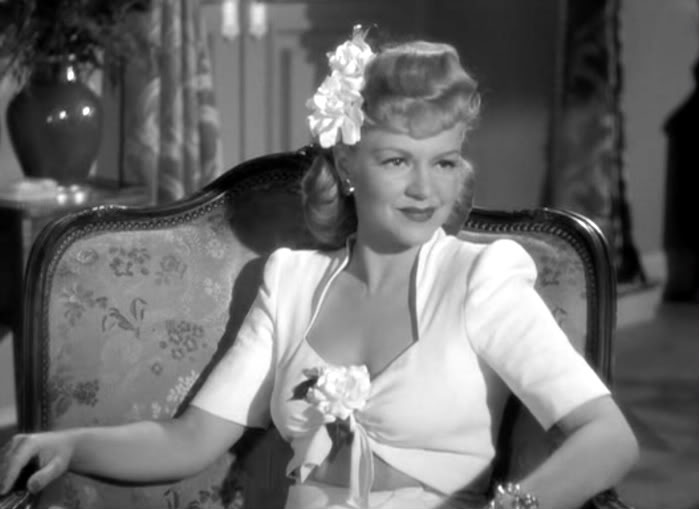
It'll probably come as no surprise that Claire Trevor's Helen Grayle is the source of that insane maliciousness. From the very first moment we see her, she surreptitiously flashes a little leg at Marlowe right in front of her husband, and her eyes have that cynical "we're playing the same game" wink. She's a great femme fatale, and even though her character's motives don't always make sense, she sells it well. Otto Kruger plays another one of the baddies, some sort of doctor who abducts Marlowe and holds him in a drug-induced delirium after Marlowe gets a little too close to the truth. He acts exactly like you'd expect an Otto would. It should be noted here, Raymond Chandler had a way of disposing of his femme fatales that was...um...interesting. Each one got a slug in the belly. Every one, shot in the stomach, and Claire Trevor is no exception. So this Chandler guy, you could say he had issues.
Powell's performance I found not quite as effective. You could see the outlines of his characterization that would work so well in later noirs like "Johnny O'Clock" and "Cry Danger," but he hadn't pinned it all down in this first performance. He had too much of a hop and a skip in his step from his musical comedy days and lacked the tough edge the role required. The over-ripe, at times silly, dialogue didn't help. Also, there's the matter of his physical appearance. In a suit he looks great , but there's one scene where Trevor comes in his apartment and sees him with his shirt off. She tells him, "You've got a nice build for a detective." He does not have a nice build for a detective. Not the broadest shoulders in the world, let's just say. Keep the coat on, Dick.
Of the supporting players, Mazurski and Shirley stand out. Mazurski's Moose Malloy has a dumb persistence that's rather touching. You start to see why someone would go along with the big lug despite his utter lack of charm and adverbs. Shirley plays her Ann Grayle with a spunky innocence that, while she wasn't born of this underworld, she could surprisingly hold her own while in it. She's like a mix of Ann Blyth and Teresa Wright. Seeing her performance makes me seriously regret the onetime child star retired after this film.
There's one final stylistic element that shouldn't go without mention, a surrealistic sequence showing Marlowe in his previously mentioned drug-induced delirium. It wasn't unusual to see hallucinogenic touches like this in the noirs that followed, but not to this extent. The whole sequence was long and elaborate, and unfortunately heavy-handed. Marlowe's hallucinations were shot so literally, like the bit with the doorways, that it was more silly than weird. And the cheap gauze over the camera, appearing and disappearing to illustrate his going in and out of delirium, was half-assed.
One more criticism, and then I'll go back to my cave. There was a kiss-cute scene in the end between Shirley and Powell, where the still blind Marlowe at first doesn't know Shirley's sitting next to him in the back of their cab before she leans in for a kiss. The problem is, Shirley's father had just been killed moments after killing her stepmother. You'd think she'd be a little too traumatized to be thinking about locking lips with Powell, at least not in the funny/cutesy way they did. Either they were made of stronger stuff back then, or Hollywood put a little too much Hollywood in a Hollywood ending.
Opening in 1944, "Murder, My Sweet" was based on the Raymond Chandler novel, "Farewell, My Lovely." It met instant critical acclaim and represented a turning point in star Dick Powell's career. Up until then, he'd been mostly known for musical comedies, but from there on he was one of the leading noir actors of the decade. Also starring, and playing more to type, were bad girl Claire Trevor and feisty babe in the woods, Anne Shirley (lamentably her last film). The title of the film was originally "Farewell, My Lovely" on release but was later changed to ensure audiences didn't mistake it for another one of Powell's damn musical comedies. Excepting that minor tweak, it remained faithful to the novel and carried over many of Chandler's signature stylings, like the ripe dialogue and the flashback first-person narrative. It also boasted a visual look that set a new standard for the genre.
The film starts off with Powell, as Phillip Marlowe, being interrogated in a police station while blinded by a bandage. Here we get that famous noir look and all its iconic elements. There's the high-contrast black and white photography, lots of shadows, thick cigarette smoke, and more fedoras than you can count (at least when drunk during a late night viewing). We also get the highly stylized dialogue that in better hands sounded tough as nails but here sounds, well, puzzling. "My bank account was crawling under a duck." Huh? "My mind felt like a plumber's handkerchief." I'm sorry, what does that even mean?
The dialogue could've been better, but what about the plot? During the opening, we're taken by flashback to the meat of the story where Marlowe is approached by Moose Malloy, played by wrestler Mike Mazurski, to find an old girlfriend named Velma. Always a Velma. Things quickly complicate when the Velma angle leads him to jewel swindlers and Claire Trevor's Helen Grayle, who's trying to buy back a rare jewel stolen by said swindlers. Helen also has a rich older husband from who's jewel collection she dabbles in, and a troublesome stepdaughter Ann (Anne Shirley) who knows a good gold digger when she sees one and doesn't like it one bit. So Marlowe is lead along into looking for the lost jewel while trying to suss out everyone's conflicting motives. In other words, who's trying to screw who?
Like all detective thrillers, the plot gets more elaborate with many twists and red herrings thrown in. It's somewhat confusing on first viewing and can be a bit of a muddle, but we assume it'll all make sense in the end, and it does. As long as you accept the insane maliciousness of whoever the catalyst is. All in all, it's fairly standard.
It'll probably come as no surprise that Claire Trevor's Helen Grayle is the source of that insane maliciousness. From the very first moment we see her, she surreptitiously flashes a little leg at Marlowe right in front of her husband, and her eyes have that cynical "we're playing the same game" wink. She's a great femme fatale, and even though her character's motives don't always make sense, she sells it well. Otto Kruger plays another one of the baddies, some sort of doctor who abducts Marlowe and holds him in a drug-induced delirium after Marlowe gets a little too close to the truth. He acts exactly like you'd expect an Otto would. It should be noted here, Raymond Chandler had a way of disposing of his femme fatales that was...um...interesting. Each one got a slug in the belly. Every one, shot in the stomach, and Claire Trevor is no exception. So this Chandler guy, you could say he had issues.
Powell's performance I found not quite as effective. You could see the outlines of his characterization that would work so well in later noirs like "Johnny O'Clock" and "Cry Danger," but he hadn't pinned it all down in this first performance. He had too much of a hop and a skip in his step from his musical comedy days and lacked the tough edge the role required. The over-ripe, at times silly, dialogue didn't help. Also, there's the matter of his physical appearance. In a suit he looks great , but there's one scene where Trevor comes in his apartment and sees him with his shirt off. She tells him, "You've got a nice build for a detective." He does not have a nice build for a detective. Not the broadest shoulders in the world, let's just say. Keep the coat on, Dick.
Of the supporting players, Mazurski and Shirley stand out. Mazurski's Moose Malloy has a dumb persistence that's rather touching. You start to see why someone would go along with the big lug despite his utter lack of charm and adverbs. Shirley plays her Ann Grayle with a spunky innocence that, while she wasn't born of this underworld, she could surprisingly hold her own while in it. She's like a mix of Ann Blyth and Teresa Wright. Seeing her performance makes me seriously regret the onetime child star retired after this film.
There's one final stylistic element that shouldn't go without mention, a surrealistic sequence showing Marlowe in his previously mentioned drug-induced delirium. It wasn't unusual to see hallucinogenic touches like this in the noirs that followed, but not to this extent. The whole sequence was long and elaborate, and unfortunately heavy-handed. Marlowe's hallucinations were shot so literally, like the bit with the doorways, that it was more silly than weird. And the cheap gauze over the camera, appearing and disappearing to illustrate his going in and out of delirium, was half-assed.
One more criticism, and then I'll go back to my cave. There was a kiss-cute scene in the end between Shirley and Powell, where the still blind Marlowe at first doesn't know Shirley's sitting next to him in the back of their cab before she leans in for a kiss. The problem is, Shirley's father had just been killed moments after killing her stepmother. You'd think she'd be a little too traumatized to be thinking about locking lips with Powell, at least not in the funny/cutesy way they did. Either they were made of stronger stuff back then, or Hollywood put a little too much Hollywood in a Hollywood ending.
Tuesday, May 27, 2014
Sergeant York (1941)
You'd think a film that was a box office hit of its day and imbued as a classic in this day would be a can't miss, but in the case of 1941's "Sergeant York," "can't miss" is definitely a miss. Intended as a rousing tribute to American patriotism and the fighting spirit, it instead is a somewhat dull agitprop that drains all drama and critical thought out of a biography that could have explored all kinds of themes relating to rural poverty, war, and state propaganda.
The film took its template from Alvin York's diaries recounting his life in rural Tennessee and his Medal of Honor winning exploits on the World War I battle fields of France. Directed by Howard Hawks and written by a committee of writers including John Huston, it stars the go-to American hero of the day, Cary Cooper, and went on to become the biggest box office hit of the year. It was even somewhat boosted by its presence in theaters during the attack on Pearl Harbor and went on to become an unofficial recruitment film of sorts.
The film begins by transporting us to the world of Wolf River Valley, an impoverished, deeply religious area of rural Tennessee. We're introduced to Alvin York as a hell-raising drunkard and devoted son, which isn't as absurd as it sounds. He works hard on the family farm to provide for his mother and siblings, and plays hard when he ain't. What's striking about these early sequences is the infantilizing lens Hawks filters these characters through. The opening scene in the church, where we're introduced to most of the town's characters, is emblematic as it treats them as children being set straight by the preacher man, played by the audibly recognizable Walter Brennan. We also meet a drunk Alvin as he shoots up a tree outside with his initials. This makes me instantly like him.
Unfortunately a beast like this must be tamed, and for the taming we got some good old-time religion. After Alvin gets swindled out of a land deal and has his rival for paramour Joan Leslie steal it away, he goes on horseback one stormy night to kill the bastard. And that's where lightning strikes. Thrown from his horse and his rifle split down the barrel, is he saved from electrocution by a merciful god or given a a jolt as a warning by a sadistic prick? Religious epiphanies are always open-ended by nature. Anyway, he gets set straight.
The Tennessee valley sequences, which take up at least half the running time, are despite these weaknesses the most entertaining part of the film. Cooper plays York as an overgrown kid, a good-hearted oaf, but he still has that Gary Cooper gleam in his eye. Joan Leslie, playing love interest Gracie Williams, is a real standout and lends some authenticity with a real-sounding Tennessee accent. The filmmaking, though, doesn't quite support the appeal of the actors. Hawks shoots in a curiously staid, old-fashioned style that looks like it was from the mid-late 30s. In fact, I was surprised to learn this was made in 1941. If I had to guess, I would've said 1937, the latest.
More problematic is Hawks' mixing of true exterior shots and studio exteriors. This simply Does Not Work, especially when characters' shouts produce unfortunate echoes on the sound stage. It gives the story a pictorial hokiness that, while not fatal, adds to the paternalism and condescension the film already suffers from.
After York's religious conversion, he undergoes the predictable personality change but goes so far in meekness and forgiving those who wronged him that it's actually jaw-dropping. He goes to the pair who chiselled him out of his land and offers to work for them, work for them, no hard feelings. What I think's going on here is the writers are setting us against that kind of turn-the-cheek pacifism so we can later accept York's rejection of his conscientious objector petition and embrace of the Army's warrin'.
This requires another religious conversion of sorts, and right on cue America enters the war. York gets drafted, and after unsuccessfully petitioning for conscientious objector status, he's sent to Fort Gordon to begin basic training. He's still a pacifist at heart, but after proving himself a crack shot on the target range, his commanding officer takes a special interest in him. The major prosyletizes a new kind of religion, one about patriotism, sacrifice, and Daniel Boone. He gives York a book to go along with his Bible, a volume of US history, and grants him leave to go home and think about it, with the deal that if he returned still convinced not to fight, he'd be granted his conscientious objector exemption.
Well, York goes home and finds the solitude of a cliffside where he takes his two books with him and wrestles with his beliefs. It's not very subtle. There's lots of inspirational music and brow-furrowing. At least we were spared a Hitchcockian kaleidoscope shot where the two books are revolving around each other like in some fever dream. What we weren't spared was a divine wind that opened his Bible to that "Render unto Caesar that stuff that's his, and unto God all that other stuff" page. Reading that passage apparently settles the matter as York returns to his unit not exactly determined to fight but not ruling it out either. It's a god's will thing at this point. Give war a chance!
So off to France we go, and this to me was the most disappointing part of the movie. There are battle scenes, but they're staged in a way that only makes use of the space onscreen. The troop movements are obviously choreographed for the frame, and Hawks never creates an offscreen world where the larger battle takes place. It's all very stagey, so the world Hawks presents never looks like anything more than a movie set. These scenes also featured the worst death pirouettes of any film I've seen. Seriously, when these soldiers were felled by gunfire, it looked like they were getting in one last audition for the Bolshoi Ballet before falling to the ground.
The sequence where York killed the couple dozen and captured the 100 or so Germans also pioneered the cliche that would show up in repeatedly in World War II films, that of the guy from the Bronx or Brooklyn getting killed just when they thought the battle won. As soon as I heard George Tobias' accent as "Pusher" Ross, I knew he was marked for death. That this was the first film that did it momentarily escaped me. I was just conditioned to expect it. Those guys were like the red shirts in the original Star Trek.
There was a void in this film that by the end took on black hole proportions. There was no discussion, no exposition, about what the war was about. Nothing about beating back Central Power aggression or defending democracy or any of the common justifications. Maybe it would have sounded too silly to 1941 audiences still with memories of the slaughter. It also reveals a fatalistic aspect of America's self-image, that we're supposed to fight, well...just because. The closest York gets to explaining why he did it was with an "it was either me or them" argument. Still nothing about the forces that transported him across an entire ocean to do it. It's interesting this doesn't get addressed.
So what do you get with a biography with little sense of drama or suspense? A story more agitprop than human? No historical perspective, no questioning of politics, that sells war as a right of passage and gateway to fame without all that other stuff? A film with stilted direction, that treats its audience like it just fell off the turnip truck?
Movie stars. You get Gary Cooper, Walter Brennan, and a young Joan Leslie, and that's about the extent of it. It's a lot more appealing than sitting through some interminable Godard essay, but I'd rather see this cast in some noir programmer than a stiff Hollywood bio.
The film took its template from Alvin York's diaries recounting his life in rural Tennessee and his Medal of Honor winning exploits on the World War I battle fields of France. Directed by Howard Hawks and written by a committee of writers including John Huston, it stars the go-to American hero of the day, Cary Cooper, and went on to become the biggest box office hit of the year. It was even somewhat boosted by its presence in theaters during the attack on Pearl Harbor and went on to become an unofficial recruitment film of sorts.
Unfortunately a beast like this must be tamed, and for the taming we got some good old-time religion. After Alvin gets swindled out of a land deal and has his rival for paramour Joan Leslie steal it away, he goes on horseback one stormy night to kill the bastard. And that's where lightning strikes. Thrown from his horse and his rifle split down the barrel, is he saved from electrocution by a merciful god or given a a jolt as a warning by a sadistic prick? Religious epiphanies are always open-ended by nature. Anyway, he gets set straight.
The Tennessee valley sequences, which take up at least half the running time, are despite these weaknesses the most entertaining part of the film. Cooper plays York as an overgrown kid, a good-hearted oaf, but he still has that Gary Cooper gleam in his eye. Joan Leslie, playing love interest Gracie Williams, is a real standout and lends some authenticity with a real-sounding Tennessee accent. The filmmaking, though, doesn't quite support the appeal of the actors. Hawks shoots in a curiously staid, old-fashioned style that looks like it was from the mid-late 30s. In fact, I was surprised to learn this was made in 1941. If I had to guess, I would've said 1937, the latest.
More problematic is Hawks' mixing of true exterior shots and studio exteriors. This simply Does Not Work, especially when characters' shouts produce unfortunate echoes on the sound stage. It gives the story a pictorial hokiness that, while not fatal, adds to the paternalism and condescension the film already suffers from.
After York's religious conversion, he undergoes the predictable personality change but goes so far in meekness and forgiving those who wronged him that it's actually jaw-dropping. He goes to the pair who chiselled him out of his land and offers to work for them, work for them, no hard feelings. What I think's going on here is the writers are setting us against that kind of turn-the-cheek pacifism so we can later accept York's rejection of his conscientious objector petition and embrace of the Army's warrin'.
This requires another religious conversion of sorts, and right on cue America enters the war. York gets drafted, and after unsuccessfully petitioning for conscientious objector status, he's sent to Fort Gordon to begin basic training. He's still a pacifist at heart, but after proving himself a crack shot on the target range, his commanding officer takes a special interest in him. The major prosyletizes a new kind of religion, one about patriotism, sacrifice, and Daniel Boone. He gives York a book to go along with his Bible, a volume of US history, and grants him leave to go home and think about it, with the deal that if he returned still convinced not to fight, he'd be granted his conscientious objector exemption.
Well, York goes home and finds the solitude of a cliffside where he takes his two books with him and wrestles with his beliefs. It's not very subtle. There's lots of inspirational music and brow-furrowing. At least we were spared a Hitchcockian kaleidoscope shot where the two books are revolving around each other like in some fever dream. What we weren't spared was a divine wind that opened his Bible to that "Render unto Caesar that stuff that's his, and unto God all that other stuff" page. Reading that passage apparently settles the matter as York returns to his unit not exactly determined to fight but not ruling it out either. It's a god's will thing at this point. Give war a chance!
So off to France we go, and this to me was the most disappointing part of the movie. There are battle scenes, but they're staged in a way that only makes use of the space onscreen. The troop movements are obviously choreographed for the frame, and Hawks never creates an offscreen world where the larger battle takes place. It's all very stagey, so the world Hawks presents never looks like anything more than a movie set. These scenes also featured the worst death pirouettes of any film I've seen. Seriously, when these soldiers were felled by gunfire, it looked like they were getting in one last audition for the Bolshoi Ballet before falling to the ground.
The sequence where York killed the couple dozen and captured the 100 or so Germans also pioneered the cliche that would show up in repeatedly in World War II films, that of the guy from the Bronx or Brooklyn getting killed just when they thought the battle won. As soon as I heard George Tobias' accent as "Pusher" Ross, I knew he was marked for death. That this was the first film that did it momentarily escaped me. I was just conditioned to expect it. Those guys were like the red shirts in the original Star Trek.
There was a void in this film that by the end took on black hole proportions. There was no discussion, no exposition, about what the war was about. Nothing about beating back Central Power aggression or defending democracy or any of the common justifications. Maybe it would have sounded too silly to 1941 audiences still with memories of the slaughter. It also reveals a fatalistic aspect of America's self-image, that we're supposed to fight, well...just because. The closest York gets to explaining why he did it was with an "it was either me or them" argument. Still nothing about the forces that transported him across an entire ocean to do it. It's interesting this doesn't get addressed.
So what do you get with a biography with little sense of drama or suspense? A story more agitprop than human? No historical perspective, no questioning of politics, that sells war as a right of passage and gateway to fame without all that other stuff? A film with stilted direction, that treats its audience like it just fell off the turnip truck?
Movie stars. You get Gary Cooper, Walter Brennan, and a young Joan Leslie, and that's about the extent of it. It's a lot more appealing than sitting through some interminable Godard essay, but I'd rather see this cast in some noir programmer than a stiff Hollywood bio.
Subscribe to:
Posts (Atom)