Today "Murder, My Sweet" is looked at as the quintessential film of the early noir cycle, setting stylistic standards for photography, atmosphere, and character that other noirs followed through the late 1940s. In reality it was soon eclipsed by its progeny as the original remains more an idea of a film than a film, its stylistic elements more artifice than hard-boiled reality. It's a bit of a lightweight.
Opening in 1944, "Murder, My Sweet" was based on the Raymond Chandler novel, "Farewell, My Lovely." It met instant critical acclaim and represented a turning point in star Dick Powell's career. Up until then, he'd been mostly known for musical comedies, but from there on he was one of the leading noir actors of the decade. Also starring, and playing more to type, were bad girl Claire Trevor and feisty babe in the woods, Anne Shirley (lamentably her last film). The title of the film was originally "Farewell, My Lovely" on release but was later changed to ensure audiences didn't mistake it for another one of Powell's damn musical comedies. Excepting that minor tweak, it remained faithful to the novel and carried over many of Chandler's signature stylings, like the ripe dialogue and the flashback first-person narrative. It also boasted a visual look that set a new standard for the genre.
The film starts off with Powell, as Phillip Marlowe, being interrogated in a police station while blinded by a bandage. Here we get that famous noir look and all its iconic elements. There's the high-contrast black and white photography, lots of shadows, thick cigarette smoke, and more fedoras than you can count (at least when drunk during a late night viewing). We also get the highly stylized dialogue that in better hands sounded tough as nails but here sounds, well, puzzling. "My bank account was crawling under a duck." Huh? "My mind felt like a plumber's handkerchief." I'm sorry, what does that even mean?
The dialogue could've been better, but what about the plot? During the opening, we're taken by flashback to the meat of the story where Marlowe is approached by Moose Malloy, played by wrestler Mike Mazurski, to find an old girlfriend named Velma. Always a Velma. Things quickly complicate when the Velma angle leads him to jewel swindlers and Claire Trevor's Helen Grayle, who's trying to buy back a rare jewel stolen by said swindlers. Helen also has a rich older husband from who's jewel collection she dabbles in, and a troublesome stepdaughter Ann (Anne Shirley) who knows a good gold digger when she sees one and doesn't like it one bit. So Marlowe is lead along into looking for the lost jewel while trying to suss out everyone's conflicting motives. In other words, who's trying to screw who?
Like all detective thrillers, the plot gets more elaborate with many twists and red herrings thrown in. It's somewhat confusing on first viewing and can be a bit of a muddle, but we assume it'll all make sense in the end, and it does. As long as you accept the insane maliciousness of whoever the catalyst is. All in all, it's fairly standard.
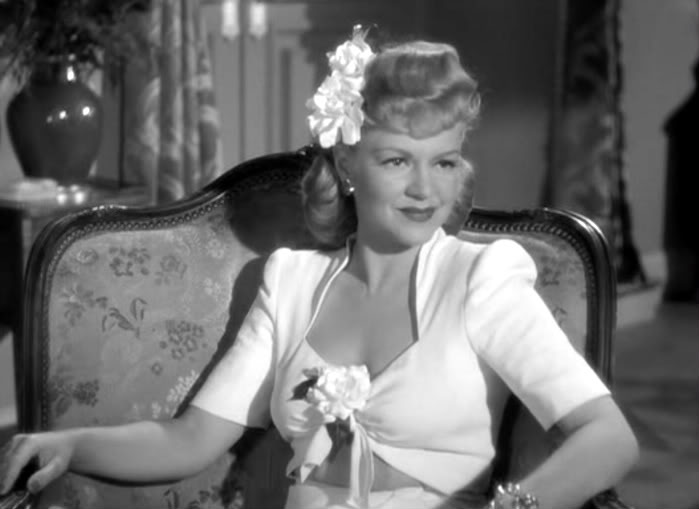
It'll probably come as no surprise that Claire Trevor's Helen Grayle is the source of that insane maliciousness. From the very first moment we see her, she surreptitiously flashes a little leg at Marlowe right in front of her husband, and her eyes have that cynical "we're playing the same game" wink. She's a great femme fatale, and even though her character's motives don't always make sense, she sells it well. Otto Kruger plays another one of the baddies, some sort of doctor who abducts Marlowe and holds him in a drug-induced delirium after Marlowe gets a little too close to the truth. He acts exactly like you'd expect an Otto would. It should be noted here, Raymond Chandler had a way of disposing of his femme fatales that was...um...interesting. Each one got a slug in the belly. Every one, shot in the stomach, and Claire Trevor is no exception. So this Chandler guy, you could say he had issues.
Powell's performance I found not quite as effective. You could see the outlines of his characterization that would work so well in later noirs like "Johnny O'Clock" and "Cry Danger," but he hadn't pinned it all down in this first performance. He had too much of a hop and a skip in his step from his musical comedy days and lacked the tough edge the role required. The over-ripe, at times silly, dialogue didn't help. Also, there's the matter of his physical appearance. In a suit he looks great , but there's one scene where Trevor comes in his apartment and sees him with his shirt off. She tells him, "You've got a nice build for a detective." He does not have a nice build for a detective. Not the broadest shoulders in the world, let's just say. Keep the coat on, Dick.
Of the supporting players, Mazurski and Shirley stand out. Mazurski's Moose Malloy has a dumb persistence that's rather touching. You start to see why someone would go along with the big lug despite his utter lack of charm and adverbs. Shirley plays her Ann Grayle with a spunky innocence that, while she wasn't born of this underworld, she could surprisingly hold her own while in it. She's like a mix of Ann Blyth and Teresa Wright. Seeing her performance makes me seriously regret the onetime child star retired after this film.
There's one final stylistic element that shouldn't go without mention, a surrealistic sequence showing Marlowe in his previously mentioned drug-induced delirium. It wasn't unusual to see hallucinogenic touches like this in the noirs that followed, but not to this extent. The whole sequence was long and elaborate, and unfortunately heavy-handed. Marlowe's hallucinations were shot so literally, like the bit with the doorways, that it was more silly than weird. And the cheap gauze over the camera, appearing and disappearing to illustrate his going in and out of delirium, was half-assed.
One more criticism, and then I'll go back to my cave. There was a kiss-cute scene in the end between Shirley and Powell, where the still blind Marlowe at first doesn't know Shirley's sitting next to him in the back of their cab before she leans in for a kiss. The problem is, Shirley's father had just been killed moments after killing her stepmother. You'd think she'd be a little too traumatized to be thinking about locking lips with Powell, at least not in the funny/cutesy way they did. Either they were made of stronger stuff back then, or Hollywood put a little too much Hollywood in a Hollywood ending.
Friday, June 27, 2014
Tuesday, May 27, 2014
Sergeant York (1941)
You'd think a film that was a box office hit of its day and imbued as a classic in this day would be a can't miss, but in the case of 1941's "Sergeant York," "can't miss" is definitely a miss. Intended as a rousing tribute to American patriotism and the fighting spirit, it instead is a somewhat dull agitprop that drains all drama and critical thought out of a biography that could have explored all kinds of themes relating to rural poverty, war, and state propaganda.
The film took its template from Alvin York's diaries recounting his life in rural Tennessee and his Medal of Honor winning exploits on the World War I battle fields of France. Directed by Howard Hawks and written by a committee of writers including John Huston, it stars the go-to American hero of the day, Cary Cooper, and went on to become the biggest box office hit of the year. It was even somewhat boosted by its presence in theaters during the attack on Pearl Harbor and went on to become an unofficial recruitment film of sorts.
The film begins by transporting us to the world of Wolf River Valley, an impoverished, deeply religious area of rural Tennessee. We're introduced to Alvin York as a hell-raising drunkard and devoted son, which isn't as absurd as it sounds. He works hard on the family farm to provide for his mother and siblings, and plays hard when he ain't. What's striking about these early sequences is the infantilizing lens Hawks filters these characters through. The opening scene in the church, where we're introduced to most of the town's characters, is emblematic as it treats them as children being set straight by the preacher man, played by the audibly recognizable Walter Brennan. We also meet a drunk Alvin as he shoots up a tree outside with his initials. This makes me instantly like him.
Unfortunately a beast like this must be tamed, and for the taming we got some good old-time religion. After Alvin gets swindled out of a land deal and has his rival for paramour Joan Leslie steal it away, he goes on horseback one stormy night to kill the bastard. And that's where lightning strikes. Thrown from his horse and his rifle split down the barrel, is he saved from electrocution by a merciful god or given a a jolt as a warning by a sadistic prick? Religious epiphanies are always open-ended by nature. Anyway, he gets set straight.
The Tennessee valley sequences, which take up at least half the running time, are despite these weaknesses the most entertaining part of the film. Cooper plays York as an overgrown kid, a good-hearted oaf, but he still has that Gary Cooper gleam in his eye. Joan Leslie, playing love interest Gracie Williams, is a real standout and lends some authenticity with a real-sounding Tennessee accent. The filmmaking, though, doesn't quite support the appeal of the actors. Hawks shoots in a curiously staid, old-fashioned style that looks like it was from the mid-late 30s. In fact, I was surprised to learn this was made in 1941. If I had to guess, I would've said 1937, the latest.
More problematic is Hawks' mixing of true exterior shots and studio exteriors. This simply Does Not Work, especially when characters' shouts produce unfortunate echoes on the sound stage. It gives the story a pictorial hokiness that, while not fatal, adds to the paternalism and condescension the film already suffers from.
After York's religious conversion, he undergoes the predictable personality change but goes so far in meekness and forgiving those who wronged him that it's actually jaw-dropping. He goes to the pair who chiselled him out of his land and offers to work for them, work for them, no hard feelings. What I think's going on here is the writers are setting us against that kind of turn-the-cheek pacifism so we can later accept York's rejection of his conscientious objector petition and embrace of the Army's warrin'.
This requires another religious conversion of sorts, and right on cue America enters the war. York gets drafted, and after unsuccessfully petitioning for conscientious objector status, he's sent to Fort Gordon to begin basic training. He's still a pacifist at heart, but after proving himself a crack shot on the target range, his commanding officer takes a special interest in him. The major prosyletizes a new kind of religion, one about patriotism, sacrifice, and Daniel Boone. He gives York a book to go along with his Bible, a volume of US history, and grants him leave to go home and think about it, with the deal that if he returned still convinced not to fight, he'd be granted his conscientious objector exemption.
Well, York goes home and finds the solitude of a cliffside where he takes his two books with him and wrestles with his beliefs. It's not very subtle. There's lots of inspirational music and brow-furrowing. At least we were spared a Hitchcockian kaleidoscope shot where the two books are revolving around each other like in some fever dream. What we weren't spared was a divine wind that opened his Bible to that "Render unto Caesar that stuff that's his, and unto God all that other stuff" page. Reading that passage apparently settles the matter as York returns to his unit not exactly determined to fight but not ruling it out either. It's a god's will thing at this point. Give war a chance!
So off to France we go, and this to me was the most disappointing part of the movie. There are battle scenes, but they're staged in a way that only makes use of the space onscreen. The troop movements are obviously choreographed for the frame, and Hawks never creates an offscreen world where the larger battle takes place. It's all very stagey, so the world Hawks presents never looks like anything more than a movie set. These scenes also featured the worst death pirouettes of any film I've seen. Seriously, when these soldiers were felled by gunfire, it looked like they were getting in one last audition for the Bolshoi Ballet before falling to the ground.
The sequence where York killed the couple dozen and captured the 100 or so Germans also pioneered the cliche that would show up in repeatedly in World War II films, that of the guy from the Bronx or Brooklyn getting killed just when they thought the battle won. As soon as I heard George Tobias' accent as "Pusher" Ross, I knew he was marked for death. That this was the first film that did it momentarily escaped me. I was just conditioned to expect it. Those guys were like the red shirts in the original Star Trek.
There was a void in this film that by the end took on black hole proportions. There was no discussion, no exposition, about what the war was about. Nothing about beating back Central Power aggression or defending democracy or any of the common justifications. Maybe it would have sounded too silly to 1941 audiences still with memories of the slaughter. It also reveals a fatalistic aspect of America's self-image, that we're supposed to fight, well...just because. The closest York gets to explaining why he did it was with an "it was either me or them" argument. Still nothing about the forces that transported him across an entire ocean to do it. It's interesting this doesn't get addressed.
So what do you get with a biography with little sense of drama or suspense? A story more agitprop than human? No historical perspective, no questioning of politics, that sells war as a right of passage and gateway to fame without all that other stuff? A film with stilted direction, that treats its audience like it just fell off the turnip truck?
Movie stars. You get Gary Cooper, Walter Brennan, and a young Joan Leslie, and that's about the extent of it. It's a lot more appealing than sitting through some interminable Godard essay, but I'd rather see this cast in some noir programmer than a stiff Hollywood bio.
The film took its template from Alvin York's diaries recounting his life in rural Tennessee and his Medal of Honor winning exploits on the World War I battle fields of France. Directed by Howard Hawks and written by a committee of writers including John Huston, it stars the go-to American hero of the day, Cary Cooper, and went on to become the biggest box office hit of the year. It was even somewhat boosted by its presence in theaters during the attack on Pearl Harbor and went on to become an unofficial recruitment film of sorts.
Unfortunately a beast like this must be tamed, and for the taming we got some good old-time religion. After Alvin gets swindled out of a land deal and has his rival for paramour Joan Leslie steal it away, he goes on horseback one stormy night to kill the bastard. And that's where lightning strikes. Thrown from his horse and his rifle split down the barrel, is he saved from electrocution by a merciful god or given a a jolt as a warning by a sadistic prick? Religious epiphanies are always open-ended by nature. Anyway, he gets set straight.
The Tennessee valley sequences, which take up at least half the running time, are despite these weaknesses the most entertaining part of the film. Cooper plays York as an overgrown kid, a good-hearted oaf, but he still has that Gary Cooper gleam in his eye. Joan Leslie, playing love interest Gracie Williams, is a real standout and lends some authenticity with a real-sounding Tennessee accent. The filmmaking, though, doesn't quite support the appeal of the actors. Hawks shoots in a curiously staid, old-fashioned style that looks like it was from the mid-late 30s. In fact, I was surprised to learn this was made in 1941. If I had to guess, I would've said 1937, the latest.
More problematic is Hawks' mixing of true exterior shots and studio exteriors. This simply Does Not Work, especially when characters' shouts produce unfortunate echoes on the sound stage. It gives the story a pictorial hokiness that, while not fatal, adds to the paternalism and condescension the film already suffers from.
After York's religious conversion, he undergoes the predictable personality change but goes so far in meekness and forgiving those who wronged him that it's actually jaw-dropping. He goes to the pair who chiselled him out of his land and offers to work for them, work for them, no hard feelings. What I think's going on here is the writers are setting us against that kind of turn-the-cheek pacifism so we can later accept York's rejection of his conscientious objector petition and embrace of the Army's warrin'.
This requires another religious conversion of sorts, and right on cue America enters the war. York gets drafted, and after unsuccessfully petitioning for conscientious objector status, he's sent to Fort Gordon to begin basic training. He's still a pacifist at heart, but after proving himself a crack shot on the target range, his commanding officer takes a special interest in him. The major prosyletizes a new kind of religion, one about patriotism, sacrifice, and Daniel Boone. He gives York a book to go along with his Bible, a volume of US history, and grants him leave to go home and think about it, with the deal that if he returned still convinced not to fight, he'd be granted his conscientious objector exemption.
Well, York goes home and finds the solitude of a cliffside where he takes his two books with him and wrestles with his beliefs. It's not very subtle. There's lots of inspirational music and brow-furrowing. At least we were spared a Hitchcockian kaleidoscope shot where the two books are revolving around each other like in some fever dream. What we weren't spared was a divine wind that opened his Bible to that "Render unto Caesar that stuff that's his, and unto God all that other stuff" page. Reading that passage apparently settles the matter as York returns to his unit not exactly determined to fight but not ruling it out either. It's a god's will thing at this point. Give war a chance!
So off to France we go, and this to me was the most disappointing part of the movie. There are battle scenes, but they're staged in a way that only makes use of the space onscreen. The troop movements are obviously choreographed for the frame, and Hawks never creates an offscreen world where the larger battle takes place. It's all very stagey, so the world Hawks presents never looks like anything more than a movie set. These scenes also featured the worst death pirouettes of any film I've seen. Seriously, when these soldiers were felled by gunfire, it looked like they were getting in one last audition for the Bolshoi Ballet before falling to the ground.
The sequence where York killed the couple dozen and captured the 100 or so Germans also pioneered the cliche that would show up in repeatedly in World War II films, that of the guy from the Bronx or Brooklyn getting killed just when they thought the battle won. As soon as I heard George Tobias' accent as "Pusher" Ross, I knew he was marked for death. That this was the first film that did it momentarily escaped me. I was just conditioned to expect it. Those guys were like the red shirts in the original Star Trek.
There was a void in this film that by the end took on black hole proportions. There was no discussion, no exposition, about what the war was about. Nothing about beating back Central Power aggression or defending democracy or any of the common justifications. Maybe it would have sounded too silly to 1941 audiences still with memories of the slaughter. It also reveals a fatalistic aspect of America's self-image, that we're supposed to fight, well...just because. The closest York gets to explaining why he did it was with an "it was either me or them" argument. Still nothing about the forces that transported him across an entire ocean to do it. It's interesting this doesn't get addressed.
So what do you get with a biography with little sense of drama or suspense? A story more agitprop than human? No historical perspective, no questioning of politics, that sells war as a right of passage and gateway to fame without all that other stuff? A film with stilted direction, that treats its audience like it just fell off the turnip truck?
Movie stars. You get Gary Cooper, Walter Brennan, and a young Joan Leslie, and that's about the extent of it. It's a lot more appealing than sitting through some interminable Godard essay, but I'd rather see this cast in some noir programmer than a stiff Hollywood bio.
Monday, April 28, 2014
The Adventures of Robin Hood (1938)
Somewhere along the line Robin Hood went wrong. He started out okay. He was an upright outlaw in good standing, robbing from the rich and giving to the poor, but a few centuries after his legend first appeared he was co-opted by the royalist influences he was previously seen rebelling against. This new Robin Hood, reborn somewhere in the 16th Century, was now an aristocrat himself. He became Robin, Earl of Locksley, rebelling against Norman usurpers to restore the one true king. In this incarnation, he wasn't rebelling against authority but against illegitimate authority, and seeking to preserve only proper lines of succession as any decent aristocratic moron would.
It's into this stale cauldron that "The Adventures of Robin Hood" plopped itself into, siding squarely with the royalist world view. Released in 1938, this highly adventurous, in keeping with the title, Robin Hood was portrayed by Erol Flynn as a dazzling, jolly rogue with a dead serious sense of honor when it came to protecting his king. When that king is dumb enough to get captured and held for ransom while journeying back from one of those Kill Muslims crusades they had back then, plots to steal his throne are abound, which offer the perfect opportunity to market Robin as a jovial rebel and ultimately as protector of the status quo.
This primacy of authority is sold to the audience from the very beginning of the film. The introductory title card expounding on the history that led us to our current laments begins with the phrase, "In the year of Our Lord, 1191..." "Our" is a pretty presumptuous adjective, but capitalizing it is downright insecure.
From there we dive right into the main conflict of the film. Sir John, Richard the Lionheart's brother, uses King Richard's absence to steal the throne for himself. There's no doubt who the bad guys are as John is portrayed as deliciously evil by an effete Claude Rains, and just to be sure of his mal-intent, the producers made him a ginger. Here he teams with Sir Guy of Gisbourne, played by a stern Basil Rathbone, to tax the populace ostensibly to pay Richard's ransom, but in reality he intends to keep it. And what of poor Richard, floundering in the wind as he helplessly awaits rescue? Well, they have assassins for that.
It seems only one man in England will resist such treachery. In swings Erol Flynn on a vine, armed with white teeth, expert arrowship, and green tights that could conquer nations. Confronting Sir John at Gisbourne's castle, Robin declares himself an enemy of John and every coward unwilling to pledge allegiance to the true king, Richard, and narrowly escapes after committing several acts of homicide in self-defense or something. Really, those luckless guards ought to unionize.
A story like this wouldn't be half as appealing without a little romance, and into that slot steps Maid Marian, played by the luminous Olivia de Havilland. Luminous and feisty, mind you, for it wouldn't be a romance without a little friction. At first, Marian isn't buying Robin's pitch. Like John, she's a Norman, and Robin's Saxon pedigree naturally puts them on opposite sides. Their relationship follows the standard pattern of films of this era. Wild beast lashes out. Wild beast tamed by master. Master and beast wed in blissful matrimony. And that's what happens here. She's antagonistic at first, seeing him as a common rebel, but she merely has the wrong allegiances. Eventually she's corrected by witnessing Robin's virility in battle and generosity to the poor and goes completely over to him. At this point she becomes one of the main drivers in the story, taking mortal risks to alert Robin of John's continuing schemes, but the taming has begun. Her heart is captured and eventually she'll settle into that conventionally happy role of being someone else's property.
Tying things up in a traditional gender binary suggests a sexual purity on the minds of the filmmakers, but there was another kind of purity being pushed here that I found just as interesting. Throughout the film, we're reminded that Robin is a Saxon, a native if you will, and John and his cohorts are Normans, interlopers to pure English lands. Robin as a Saxon is not only defending his true king but also a purely English England against foreign invaders of an unseemly sort. Of course, the Celts probably felt the same way about the Saxons when the Saxons invaded, but that's just historical context. I mean, why even...
All this regressiveness is packaged in possibly the handsomest production of its day. The three-strip Technicolor must have looked spectacular back then and still does. The blue skies and green of the forests had never looked so true, and the characters' costumes run the gamut of practically the full color spectrum. Erol Flynn became a star in black and white, but the color cinematography suits him better than anyone else I can think of. He comes to life and commands every moment, even if he was a somewhat awful "technical" actor.
This was his third pairing with de Havilland, and it's easy to see why Warner Bros. went back to that well. They have chemistry and also an ease together. Not a dull familiarity, but rather they seemed to genuinely enjoy one another. The same can be said for the entire supporting cast. Every performer fit their character like a glove and had the vibe of a Shakespeare company that had been at this a long time.
The script took no risks and that's probably how audiences wanted it. This was an adventure film, so the emphasis was on the action. No time for existential ditherings in this one. It simply introduces us to the bad guys, brings in Robin as the hero, and they all have at it. Another binary without subtlety. Good vs. cartoonish evil, no grays or ambiguities allowed. Finally, they couldn't resist wrapping things up in an all-is-well-in-the-world nuptial. I guess divorce rates had to skyrocket before writers gave up on that trope.
If there's one thing that stood out for me more than anything, it's Flynn's physical exuberance. The way he runs and jumps and darts all over sets him apart from, say, a Bogart or a Gable. With his wide, broad-toothed smile and his hearty laugh, he has no contemporary. He's spry, doubtless, and without the weight of the world on his shoulders. Fighting to restore a warlord over a usurper warlord never looked like so much fun.
Monday, March 31, 2014
Bad Day at Black Rock (1955)
I was all set to dislike this movie going in. Partly it was the presence of Spencer Tracy, whom I've never been partial to. Something about him always struck me as misanthropic, like there was an innate mean streak underneath, even in his comedies. Also, the premise of the film, about a one-armed man who asks a few wrong questions in a desert town and finds his life in danger for it, seemed too contrived. I don't usually go for those one-man-against-the-world stories, but here I was and in the interest of open-mindedness I'd try to keep an...open mind.
The film immediately gets off to an interesting, even rip-roaring, start with several shots of a Southern Pacific train speeding through the Southwest desert. This isn't a quiet, smooth ride. Instead, director John Sturges shows it as a series of kinetic shots, as though the train were careening toward a dangerous unknown. Not a bad use of an opening credit sequence.
Eventually the train stops in Black Rock, small town in the middle of the desert that doesn't get too many visitors. To call it a small town doesn't do its smallness justice. There's one road lined by a few buildings, including a jail, diner, telegraph office, and a seldom used hotel. It looks like a section of a larger town dropped from the sky. Into this world steps Tracy as John Macreedy, a bit of a mystery man in a dark hat and suit. He also only has the use of one arm.
The townfolk, mostly cowboys from a nearby (unseen) dude ranch are immediately suspicious of this newcomer. Included are Lee Marvin at his infuriatingly best and Ernest Borgnine as that dumb-as-a-rock grinning sadist everybody knows from high school. Also around is Anne Francis who appears to be the only woman in Black Rock. The story doesn't delve into that one. When Macreedy asks around how he can get to a place called "Adobe Flats," suddenly everyone clams up at those seemingly innocent words.
Enter Robert Ryan as Reno Smith, the ranch boss, who gets word of this stranger asking questions and fires off a telegraph to his man in LA to find out all he can about this Macreedy. Don't we all wish we had a man in LA?
It's here where the writers pull a clever trick and out the townspeople as hiding something sinister. Macreedy could've just waltzed into town and told the whole story, that a Japanese-American comrade saved his life in the war and that he was returning a posthumous medal to the man's father, a Mr. Komoko at Adobe Flats. At that point, anybody could've made up some plausible sounding story about Mr. Komoko's absence and sent Macreedy on his way. Instead, the writers withhold all that and have Macreedy just mention Adobe Flats. Like he's scratching a scab and trying to dig deeper at something he has no business in. Is he a cop? A private investigator? By having Macreedy hold back, the writers give Smith and company a chance to assume the worst and act guilty as sin. They're afraid. They're all bluster and intimidation, and underneath they're afraid.
The town's hostility at his wanting to visit Adobe Flats only arouses Macreedy's suspicions, but he gets there by renting a jeep from Francis's Liz Wirth and finds the charred remains of a farm and an unmarked grave. It's now apparent the sinister secret everyone's hiding is a murder, and it's not hard to guess the motive. Mr. Komoko was Japanese-American, and in the days after Pearl Harbor, someone was determined to make him pay.
After one of those "I know and you know I know" conversations between Macreedy and Smith, Macreedy senses his life is in danger if he sticks around, and that's a problem. There's no easy way to escape Black Rock, plopped in the middle of the desert as it is, and he has to wait 24 hours for the next train to come. Hence the "Bad Day" of the title.
Actually, the bad day turns to bad night as Smith and his cohorts prepare to carry out their sentence while Tracy fights a mental and physical battle of survival. I've probably given too much away, but I don't think I'd shock anyone by saying the ending adheres to the Hays Code.
I think what's most striking about this film is how it's a traditional western in a lot of ways, but the West of this film isn't about freedom or wide open spaces. This Old West is menacing and threatening. There are open spaces, but they're not an invitation to adventure. That dried up desert is an invitation to suicide and an illustration of the huge distance between Tracy and any potential help. There's a lot of big sky, too, but it's strictly used as background prop. Many times the characters are filmed in closeup with only the sky as background, which lends them an abstract appearance and draws out the unspoken evil behind those nice, polite smiles. That silent menace was the kicker for me. It made me really enjoy this film.
"Bad Day at Black Rock" isn't without its flaws. I have to mention the music score. It's an orchestral score, but aside from a bit of harmonica thrown in, it's basically a '50s melodrama score you'd expect to find in a Douglas Sirk film. It's way overheated, and loud. It's of its time. Like an '80s Vangelis score, it's of its time.
The one real problem I had with the plot was the believability of Anne Francis's final betrayal. It didn't make sense that she'd rat out her brother when he tried to help Macreedy get away in the night. After all, she'd said earlier the only reason she was still in this town was to protect the kid. Even if there was some rationale, I still didn't buy that she's lead Macreedy into that final confrontation like a lamb to slaughter. That's pretty cold-blooded, and I never got a sense her character was capable of that.
Finally, it's a bit of historical irony that although this story centers on an Asian-American character there are no Asian characters onscreen. To say there was a dearth of Asian parts in Hollywood at this time is an understatement, and that sad fact is not the sole responsibility of this film. However, for a story that makes racial hatred so prominent, and the plight of Japanese-Americans so prominent, it's a little odd not see see a single Asian onscreen. Not even as a member of the state police at the end as a bit of irony? It could have happened, but I'm not sure the filmmakers even considered it.
Thursday, March 6, 2014
Bonnie and Clyde (1967)
"Bonnie and Clyde" was the French New Wave come to Hollywood. Or rather, Hollywood taking bits of the French New Wave and repackaging them for mass appeal. And judging by its reception, box office, and now-classic status, it worked, though more as an exercise in calculated trendsetting than a step forward in cinematic expression.
Produced and pretty much brought to screen by star Warren Beatty, the film tells the well-known story of Bonnie Parker and Clyde Barrow, two Depression era outlaws who shot to fame after the release of captured photographs showing them cavorting and posing with their wares (and in Bonnie's case a famous cigar) during their multi-state crime spree. In the hands of director Arthur Penn, it became a glamorous, seriocomic adventure with some heavy-handed psychpop thrown in (got phallic symbol?), wrapped up in Godardian and Truffault-like flourishes. Nevermind the two French auteurs were feuding.
The film announces its intentions from the very beginning. Faye Dunaway as Bonnie pouts boredly in her bedroom waiting for just the right gangster to come and take her away. The scene is all hand helds and jump cuts, but when Clyde shows up and Bonnie dresses and rushes down to meet him, the film returns us to the comfort of traditional Hollywood narrative – movie star closeups, conventional editing, static camera work. This stylistic give and take is repeated throughout, but with the New Wave aesthetic never gaining preeminence. It's just window dressing meant to advertise a coolness and flatter its audience as in-the-know.
One area the film does innovate is with its narrative jump cutting. It doesn't waste much time with setup, the screenwriting equivalent of an establishing shot. Instead, it cuts right to the action, like when Clyde announces to a foreclosure victim, "We rob banks," and the film cuts mid-sequence to them robbing a bank. This abrupt change of pace, fast-paced cutting in the storyline, is the film's most compelling feature and was probably the main reason behind its success with audiences. Boring it ain't.
Another attempt at something new was the violence. This was bloodier than anything Hollywood had ever served up. We never saw squibs used to simulate exploding bullet wounds before. The gunshots were louder. Changes of tone more abrupt. You'd think it would make it all the more shocking, but it was just the opposite. "Bonnie and Clyde" wasn't the forerunner of a cinema more conscious of brutality and the reality of its consequences. Instead it foretold John Yoo's balletic violence, violence as beauty, or Tarantino's violence as irony, in addition to countless action flicks with body counts (and squib counts) to numerous to tabulate.
The violence in "Bonnie and Clyde" was commercial. It was to get people talking, but it failed to achieve an artistic statement because it could never separate itself from the undeniable glamor of the film. And if you think undeniable is a lazy word, look at Beatty and Dunaway again. The point is, where the violence complemented the old-style, Hollywood glamor is where the film fails itself. The violence served the glamor of its stars, never undercutting it. Bonnie and Clyde were portrayed as always likable with charisma in spades. Especially with the police portrayed as mostly faceless cutouts, there was no question who we'd root for. Penn and company left no room for it.
Inevitably, talk of "Bonnie and Clyde" leads to the subject of antiheroes, but these aren't antiheroes in the sense of those so prevalent in '40s noir. Dunaway's and Beatty's Bonnie and Clyde are a glossy reproduction. No effort is given to explore their dark sides, and dark sides they had. They didn't just kill cops. They killed plenty of civilians, too. There was some effort to explore a psychosexual theme with Clyde's impotence, but it was played merely as a contrasting symbolism rather than a serious informing of a character and his motives. There was also an effort to draw on motives of class struggle, with Clyde saying repeatedly, "I ain't against them," after almost getting his head torn off by an employee in a robbery. This comes across as something tacked on to, again, increase his likability factor, but the injustices of the Depression are only a backdrop to serve the character. He isn't born of this backdrop as Edward G. Robinson's Rico Bandello was of the backdrop in "Little Caesar" or James Cagney's Tom Powers was of the setting in "Public Enemy." Clyde was still Warren Beatty from Hollywood.
So what's the takeaway? Is this about the seduction of Hollywood's star machine? Is it a meta message about pushing violence forward purely for visual appeal and to satisfy an audience's thirst for the aesthetical new? If the goal of the film was to shake things up and offer Hollywood a new toolkit they knew would succeed at the box office, then it was a success. But if the goal was to confront audiences with violence in a way that made them question their previous perceptions and the way Hollywood uses violence for entertainment, then it's a missed opportunity. Even in the final death scene, Bonnie and Clyde's bodies are riddled with bullets in romantic slow motion, the film passing up a final chance to confront the audience with brutal reality, instead clinging to the old Dream Factory mindset, a new Dream Factory but a Dream Factory nonetheless.
Late in the film, Bonnie wistfully states, "When we started out, I thought we were going somewhere. But this is it. We're just goin'." Kind of like this film artistically.
Subscribe to:
Posts (Atom)


